During the Enlightenment, ideas spread at the speed of a letter. The scholars of Europe formed a complex web of correspondence, sharing thoughts, criticism, books. Crucially, they did not just consume the ideas of others and use them for their own private projects. The intellectual environment was vital and productive because it encouraged reciprocity.
Until recently, we saw something similar in the epistemic environment of tech: software developers voraciously consumed knowledge, yes, but they also shared knowledge. Take, for example, the use of Stack Overflow. Here we have a central locations where questions can be asked, answers suggested, criticized, hopefully accepted, and later found by those facing the same problems. For the generation of software developers before the arrival of LLMs, Stack Overflow was an intellectual commons.
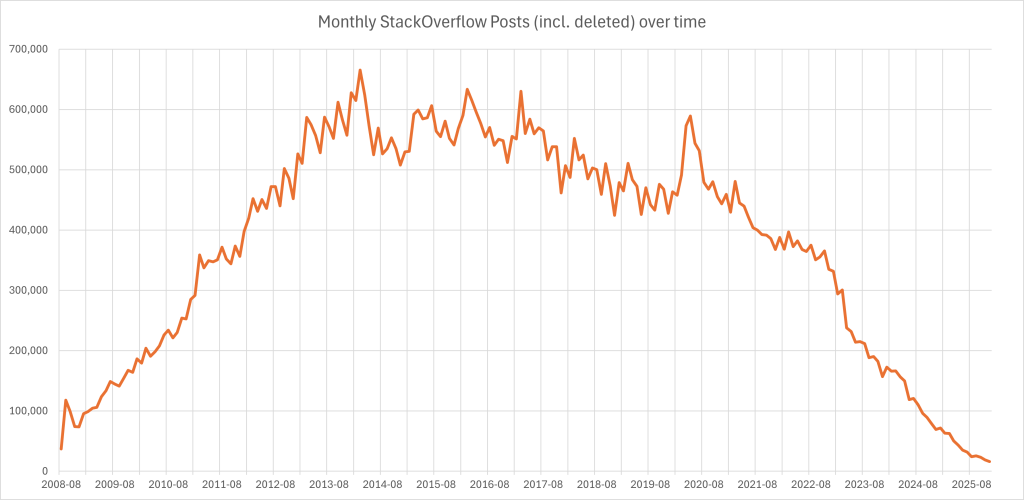
But the rise of coding with the aid of LLMs has demolished the commons. The answers to previous questions are still there and they are heavily mined by LLM agents looking to solve problems. But new questions are kept private, and if answers are found, they, too, stay private. Consider, the decline in Stack Overflow contributions over the last several years:
And just in 2025:
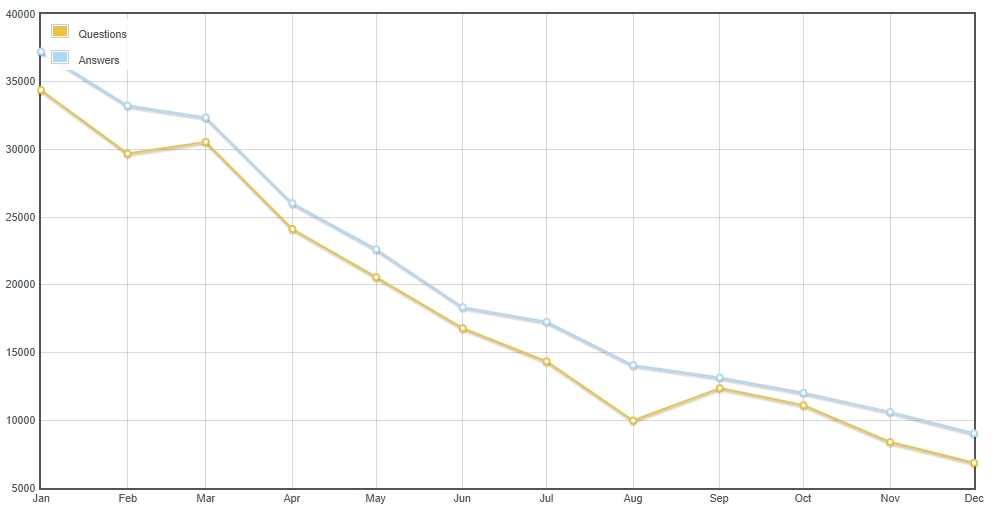
Assuming that this is emblematic of a broader imbalance between knowledge consumption and knowledge sharing, it raises a significant practical concern: LLM reliability will decline as the public knowledge base from which they draw grows stale.
I have some initial thoughts on how to combat this. First, AI companies could view knowledge sharing as an essential investment in the future of their products and create harnesses where-by (non-proprietary) questions are posted to fora like Stack Overflow and the solutions that work are posted as well. Second, knowledge sharing could be monetized such that a pay-walled forum could be created where contributors are payed out for every time their question is viewed or their solution is adopted. Third, knowledge sharing could be viewed as a professional responsibility for those in the tech sector, as it is for those in academia.
All three of these suggestions face significant problems, but they all seem to me to be worth further investigation.

